Nyx is the newest SLOPArena fighter. She swaps between two forms, a bit like Zelda and Sheik in Melee. Her real form is an actual goth who fights as a shadow witch. Her fake form is a goth influencer who brawls with her phone and the ring light on her backpack.
On 28 October at 19:41 she was a one-line idea in a chat. 22 hours later, 9 of them asleep, she was playable in both forms, with 24 animations of her own, her effects, and an engine change so a fighter can have forms at all. This page shows how, including what went wrong.


All in one T3 Code window.
How I work with the agents
I talk to one coordinator thread (Claude). It doesn’t build much itself. It writes briefs, hands them to other agent threads (OpenAI Codex or Claude, picked per job), then checks what comes back before showing it to me. On Nyx it ran 30 of those tasks and was itself busy for only about two hours of the 22. I give direction, say yes or no, and play the result. The tools that make this work are at the end of the page.
The evening: finding her look
Most of my prompts went here. Codex generated three or four concepts per round, with the real roster as a reference, and I picked or rejected.

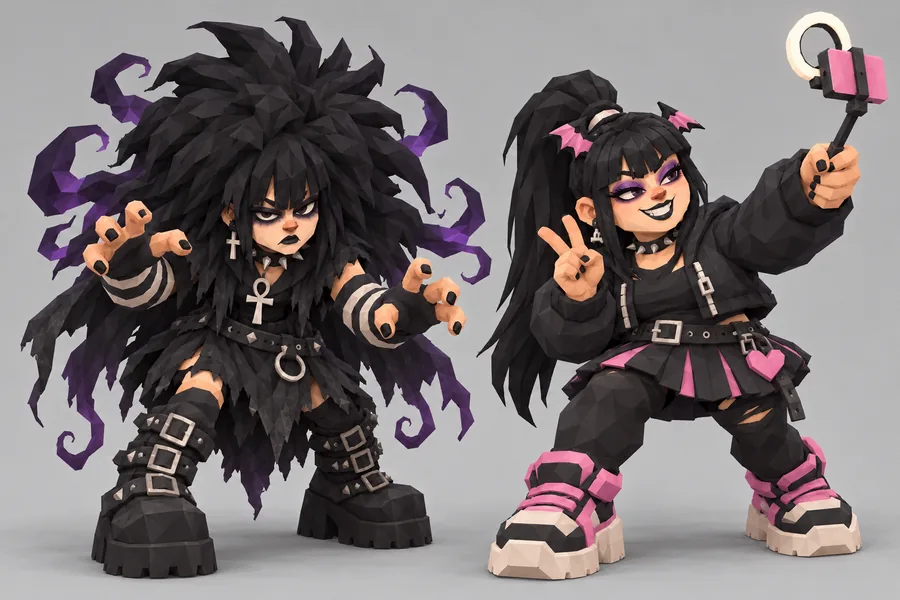
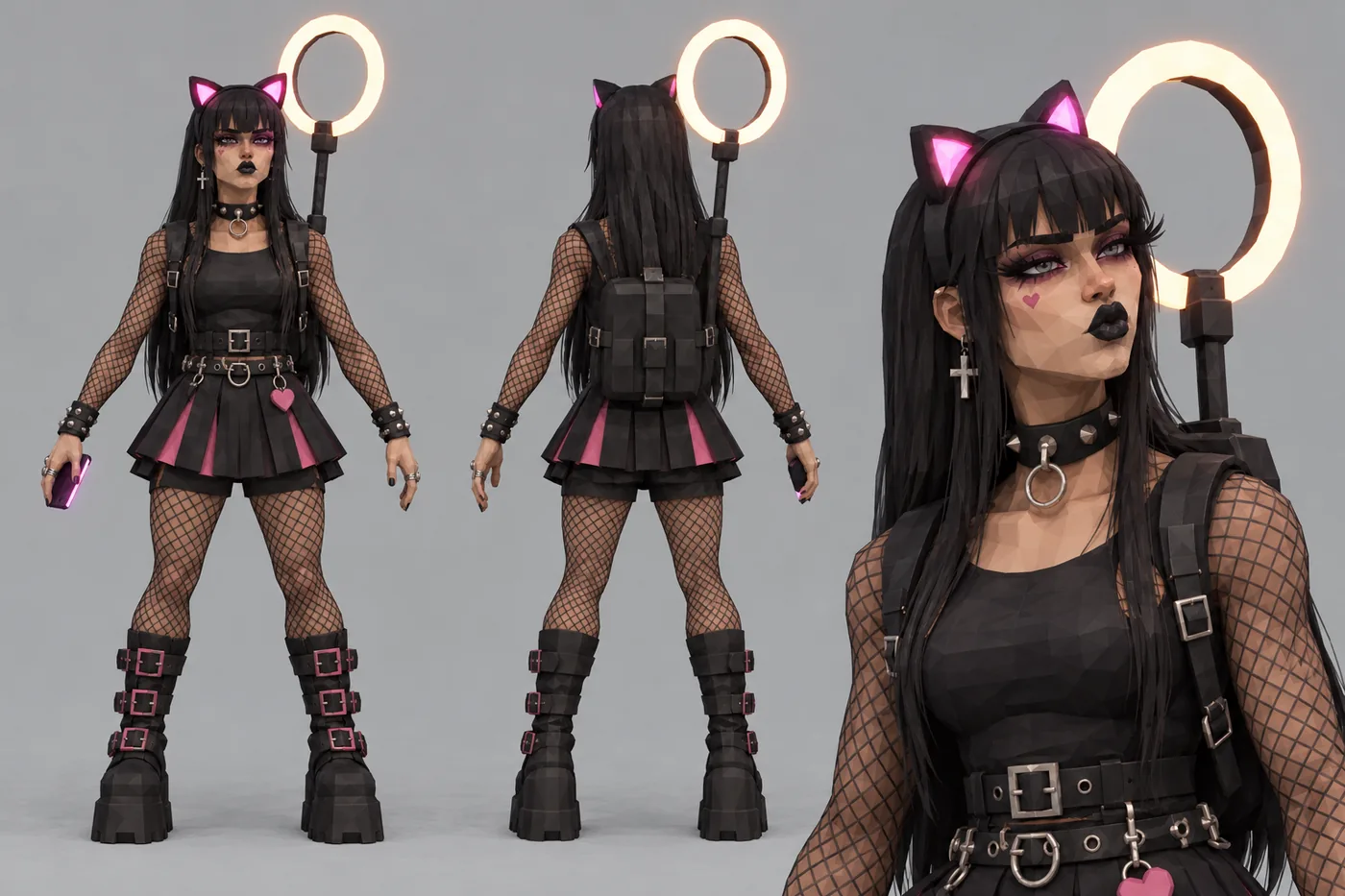
The real form locked in round 4: straight posture, straight hair, white face, more jewelry. The fake form took three more rounds. Round 5 came back as costume-shop goths, which wasn’t the brief at all (“Those are not fake goth girl concepts? I’m confused why you did those”). The reference I had in mind was the goth OnlyFans e-girl, and the trick was to make that read as a parody without sexualizing her. Round 7’s parody take won, minus one of its two phones.
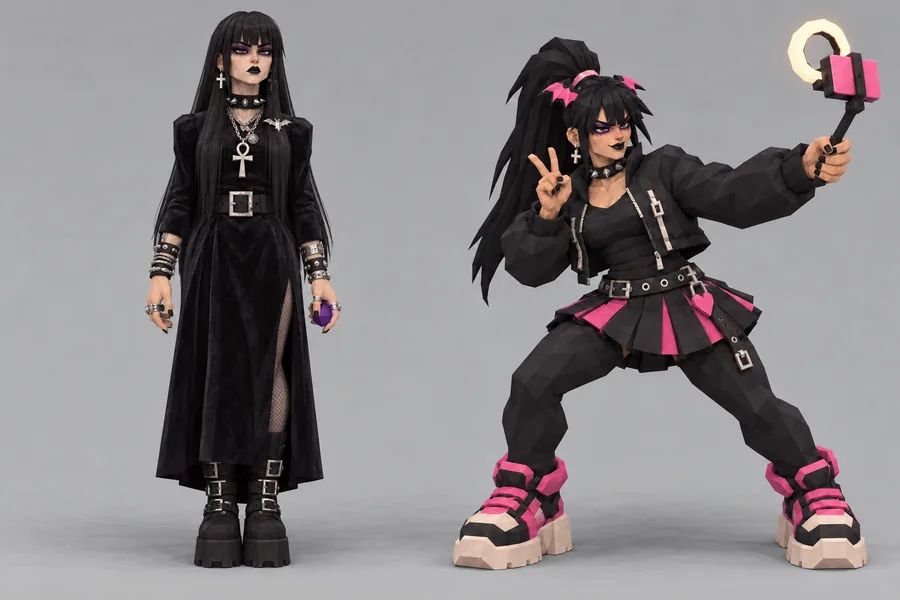

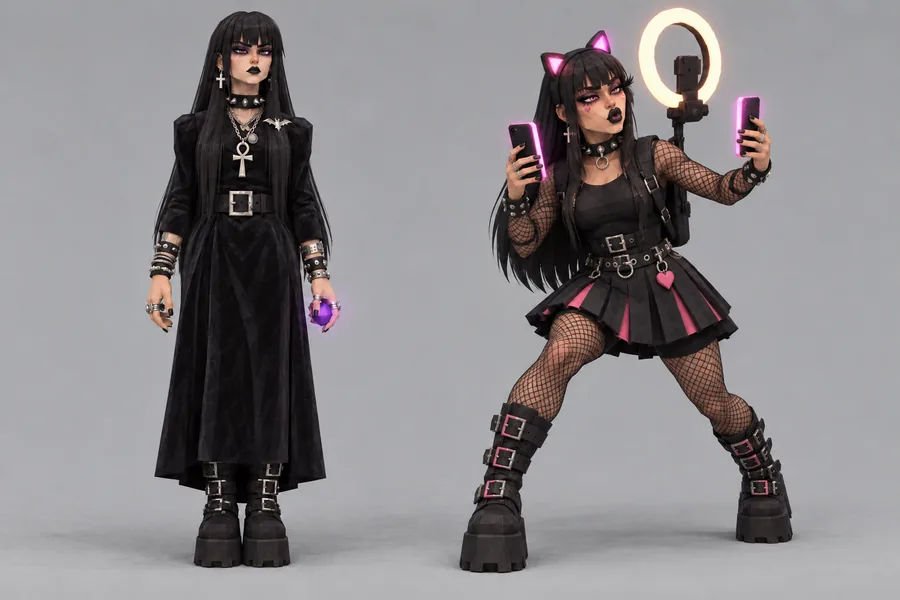
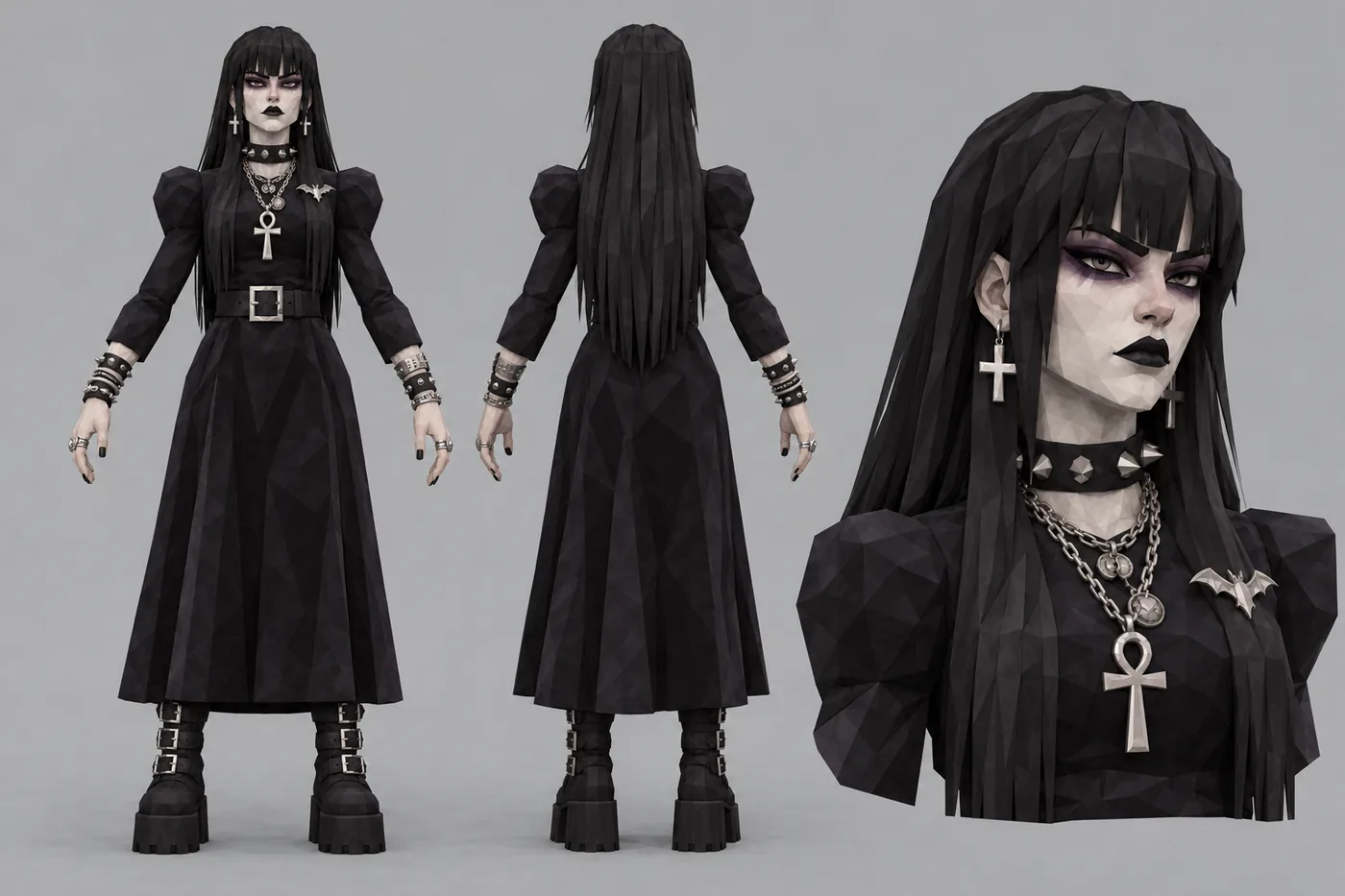
Then one sheet per form, front, back and face, which I approved as is.
The kit
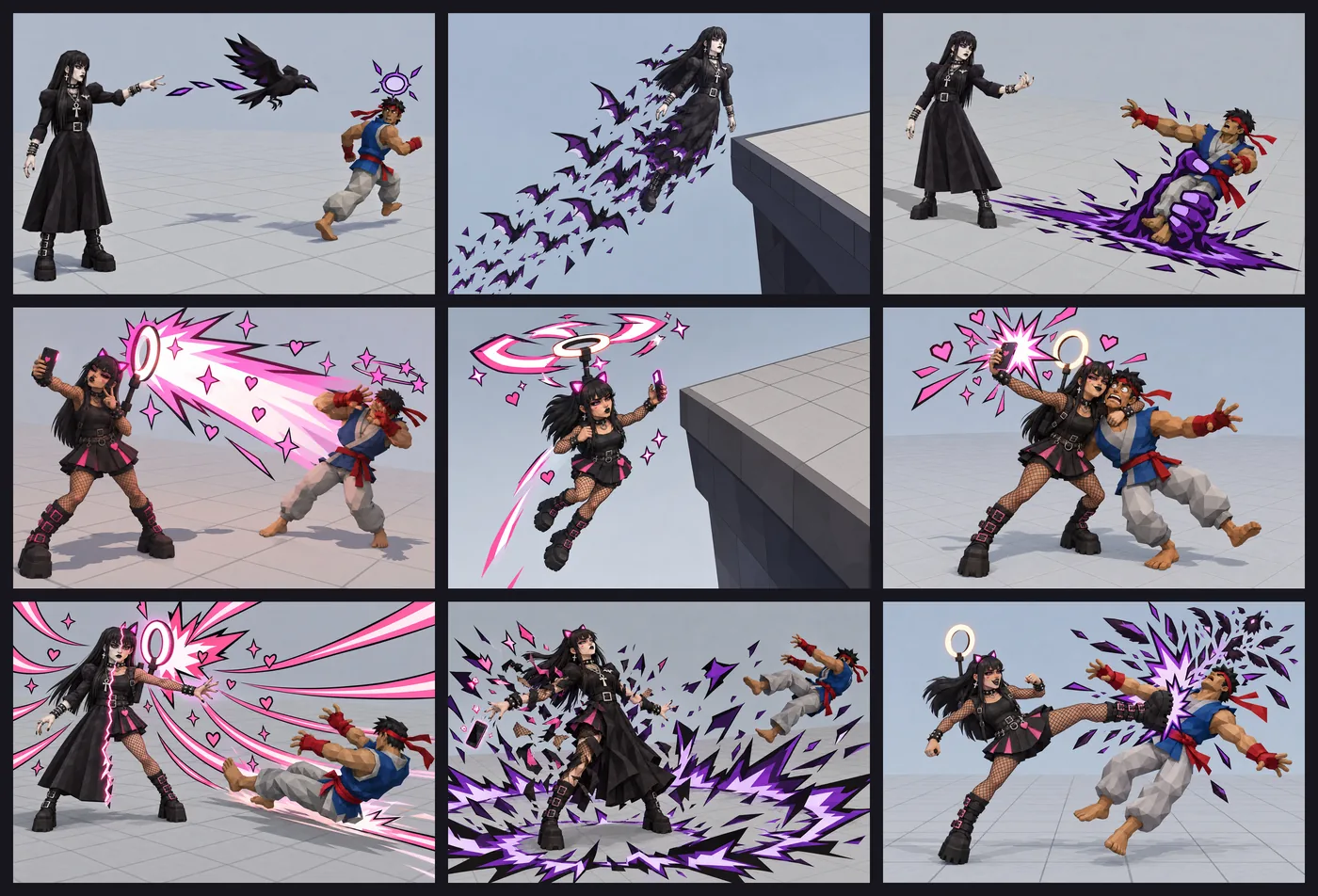
I asked for each form to be good on its own, with swapping as the fun combo tool. The real form is a calm zoner whose shadows do the hitting: Hex Crow (a slow homing crow that perches on you), Bat Scatter (she becomes bats to recover) and Grasp (a shadow hand drags you in). The fake form is a fast brawler: a Ring Light flash, the ring light spun like a rotor to recover, and Selfie Grab. Swapping on F hits too. Going Live pulls the opponent in, Logging Off pushes them away. The coordinator painted every special as a concept frame before anything was built.
The night: models
From the approved sheets, the agents made clean front, back and side inputs. I ran them through Tripo to get one 3D model per form. Before I went to bed, the coordinator started four tasks: 24 pose sheets, the model prep for Mixamo, and the engine design for forms. I answered its six design questions in the morning, together with the two Mixamo rigs.
Build day
From 10:49 to about 16:15, 15 tasks ran, up to three at once.
- One body, two meshes. Both forms share one skeleton, and swapping changes which mesh is drawn. The first package used FightGuy’s animations as stand-ins, so the whole kit was playable in Training by lunchtime.
- The engine, in four phases. Forms and the swap, then her normals and simple specials, then Grasp, Hex Crow and Selfie Grab, then the CPU, the HUD and Ability Lab. After the phases, the coordinator reran the tests and checked that the other fighters’ data hadn’t changed.
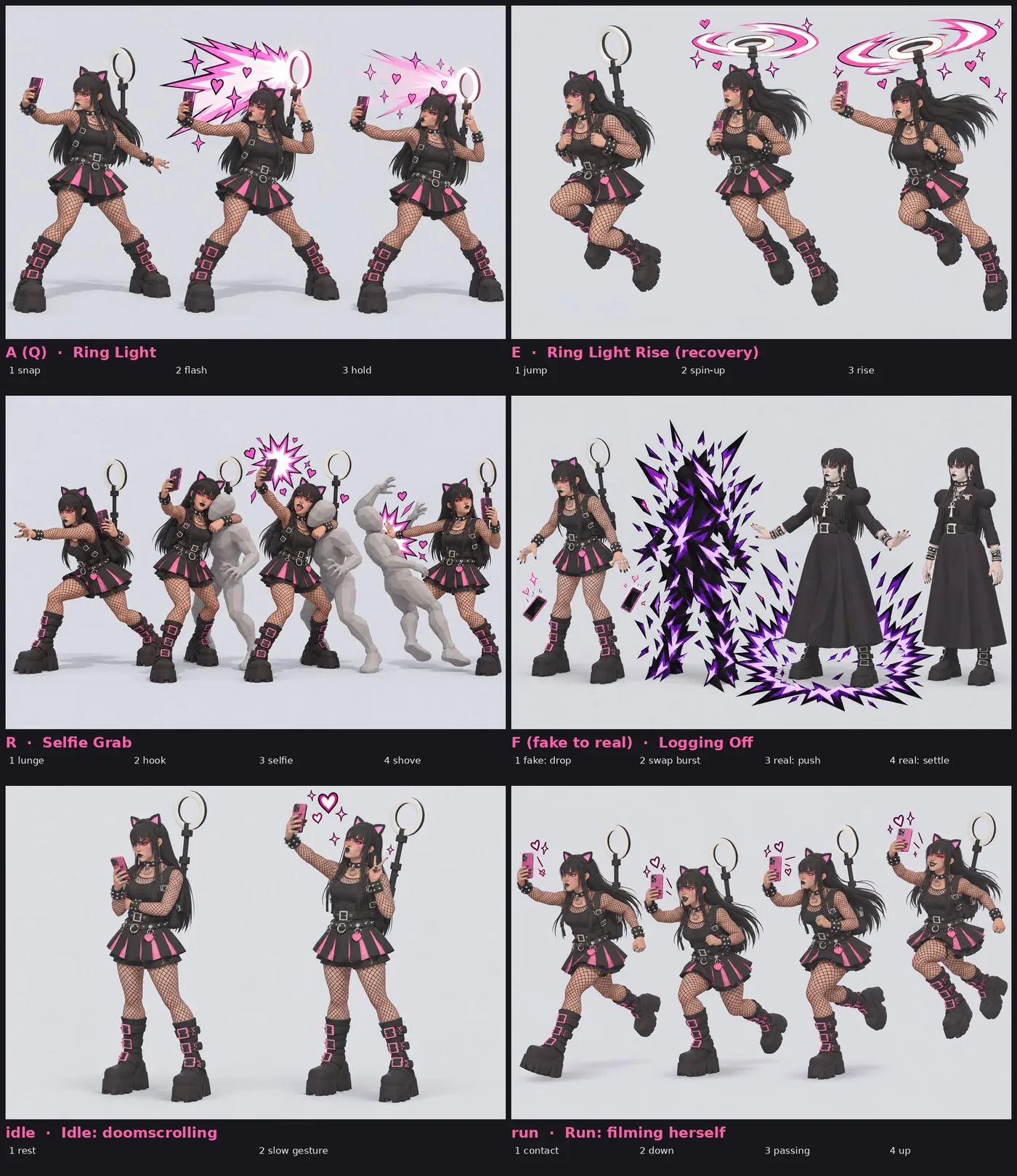
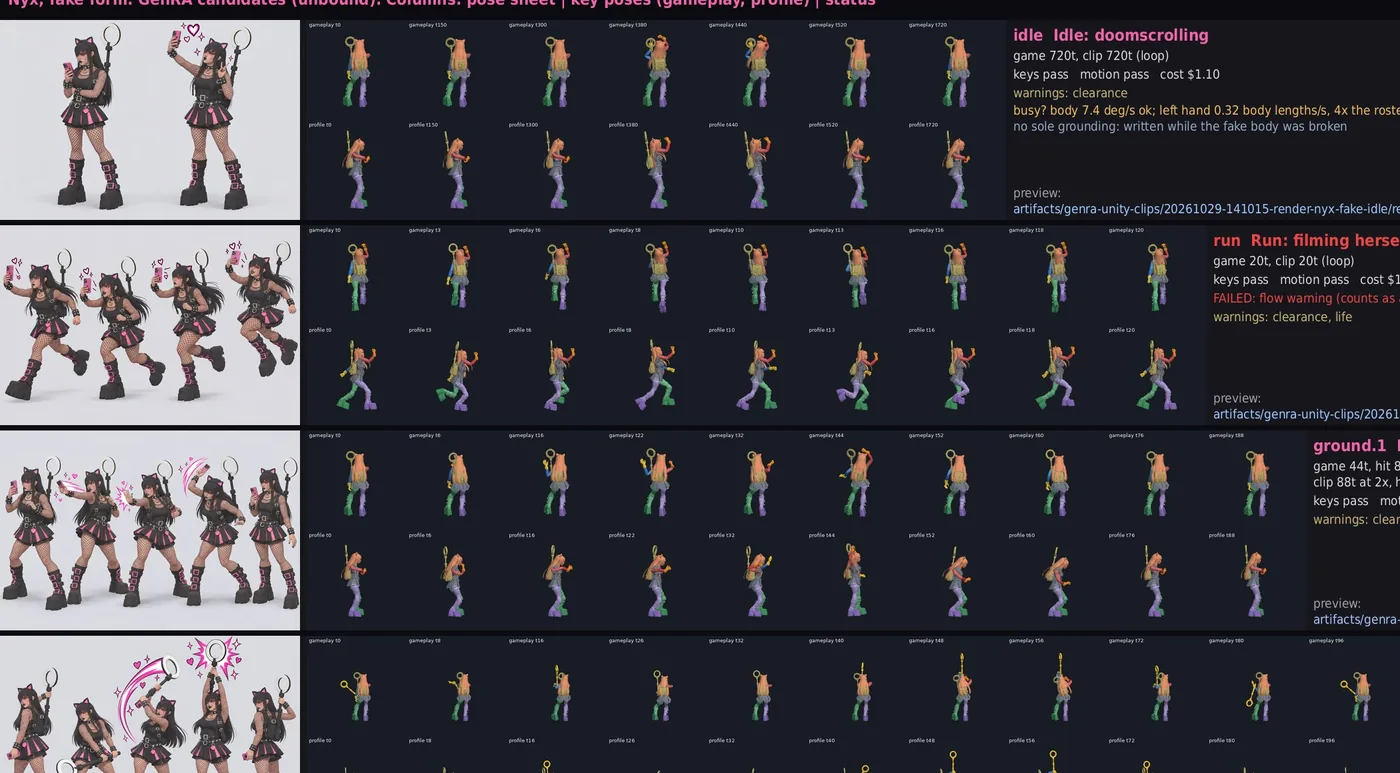
- Her own animations. 24 moves through GenRA, one round, $43 in total. 20 passed the automatic checks. I approved all 24 after one look.
- Effects. Painted as concepts over her own animation frames, approved, then built.
What went wrong
Five of the 19 build tasks were rework, and two of my seven prompts after the design were bug reports.
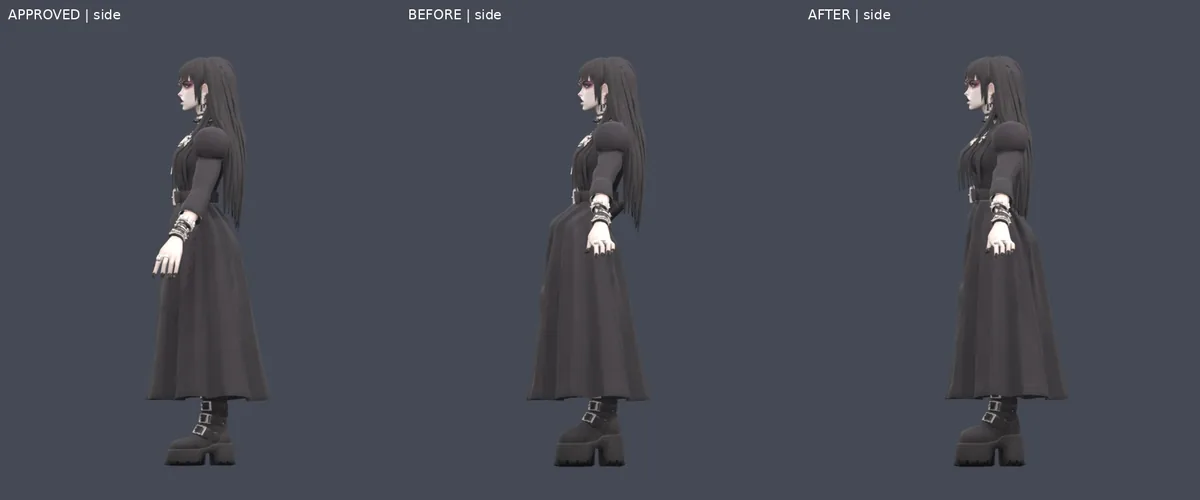
The dress. Unity Cloth failed twice on the real form’s long dress. The first try spread her legs under it. The second rested like a lampshade and collapsed between her legs when she ran. The third try kept the approved dress shape and hung it on 12 spring bone chains, with no cloth simulation at all.
The broken spine. A bit later I asked “it looks like she has a broken spine?”. Fitting the real form onto the shared skeleton had kept her torso exactly as modelled, but the skeleton’s spine sat 2 to 6 cm in front of it. A refit to the skeleton fixed it.
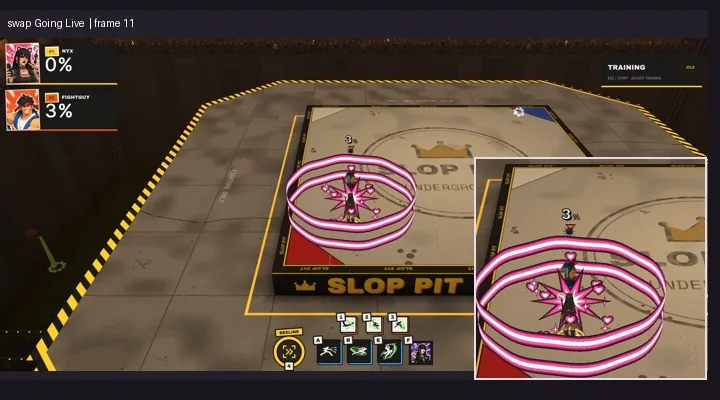
The effects. The concepts were great. The build turned flat comic drawings into flat cutouts: 15 of 25 effect meshes had no depth at all, and from the game camera Going Live looked like stacked pink tape. A depth pass is running as I write this.

The whole thing on one timeline
Every prompt, task and video, read back from the coordinator’s own log. Hover the interactive version for the text of each prompt and the details of each task.
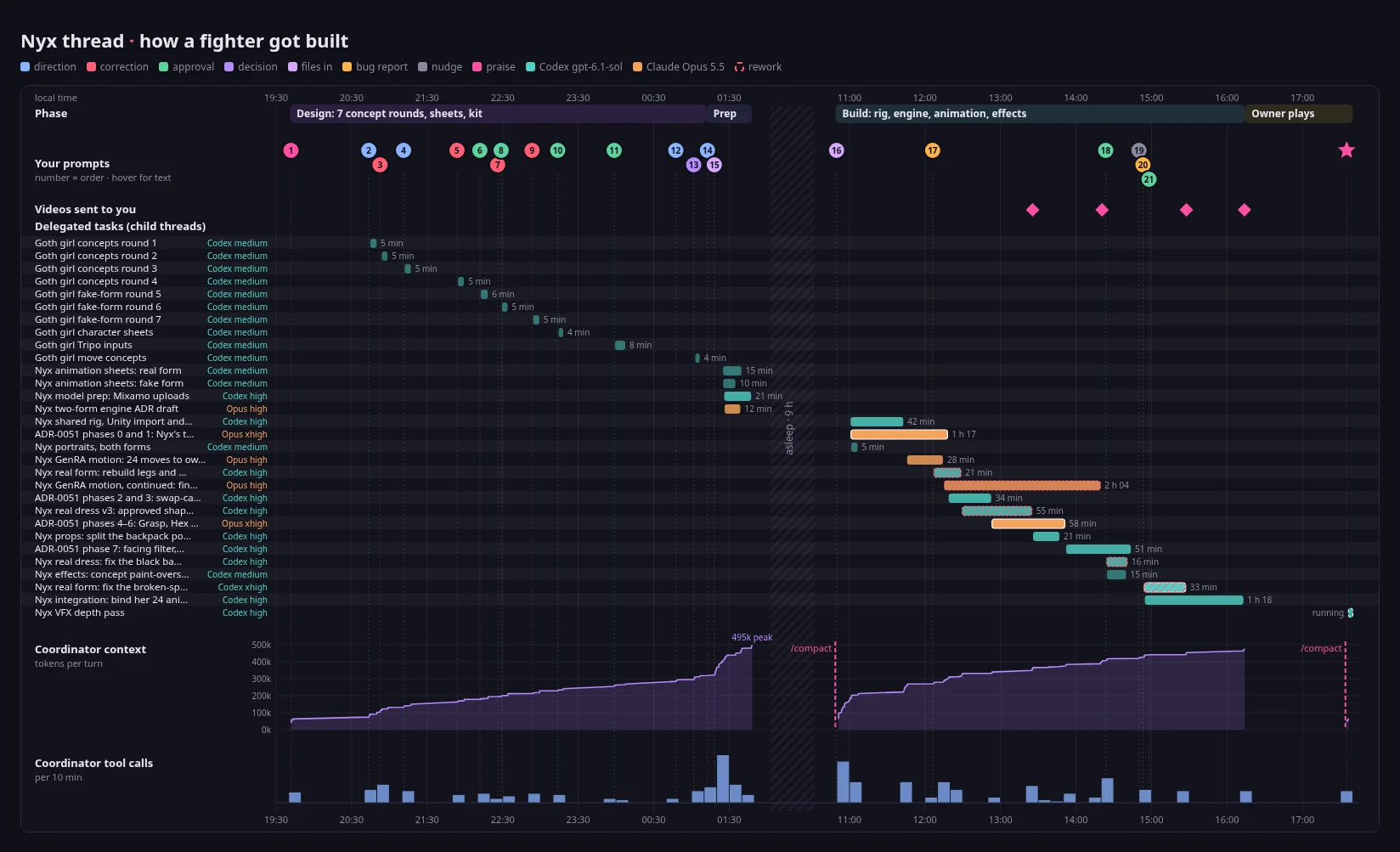
- 14 of my 21 prompts came before any build. Taste is the slow part, and it’s mine.
- The coordinator stayed small. It handed out the heavy work and filled its context only twice. Both times I compacted it at a natural break.
- I answered fast when it mattered. The median reply was 12 minutes. During the dress and spine fixes, it was 2 to 3.
The tools behind it
Nyx took 21 prompts because the game had already taken thousands. A fighter is data here, not new code, and every step of her build ran on tools made for the fighters before her. Four of them do most of the work.
T3 Code: one window for every agent
T3 Code ↗ is an open-source app for running coding agents, made by the Ping.gg team. I run Claude and Codex threads side by side in it, all on the same copy of the game. Two things made the Nyx run possible. A thread can hand a task to a new thread on either provider, with the model and effort it chooses, and gets the report back when it’s done. And pictures, pages and videos show up right in the conversation, so I review concept boards, animation takes and this timeline where I chat, often from my phone.
pstack: how the agents work
pstack ↗ is a free pack of agent skills by poteto, an engineer at Cursor. It gives agents a method instead of a blank page. A task gets routed to a playbook (investigate, build a feature, fix a bug), and every playbook carries principles like “prove it works on the real thing” and “fix the root cause, not the symptom”. It also decides which model does which job. On Nyx, Codex built most things and Claude Opus took the judgment calls and the hardest engine work. And it makes the coordinator keep a decision log: 40 lines of what it decided, why, and how it checked. Without that file, this page couldn’t have been written.
The Unity gateway: many agents, one Editor
How do this many agents not step on each other’s toes? Almost everything they do ends up in one Unity Editor: importing models, cooking the fighter, playing Training, recording clips. Unity does one thing at a time. If one agent starts a recompile while another is recording a capture, both break.
So I built a gateway in front of the Editor, on top of a fork of Unity’s Pipeline package. Agents never drive Unity directly. An agent hands the gateway a batch, like “import these clips, cook Nyx, open Training, record the swap”, and gets a lease. Everyone else waits in line. The gateway checks who is asking, so no agent can run on another’s lease, and it recompiles before every batch so nobody records stale code. When I want to play, a “Hold Editor for Me” switch puts me at the front of the line, and the agents wait until I’m done.
On 29 October, the transcripts show this traffic, Nyx’s and other fighters’ together:
GenRA: an AI that animates with code
Nobody hand-keys her animations. Our animation toolkit is a fork of GenRA ↗, research from MacPaw by Andrii Yaroshevych, Pavlo Kryven, Mariya Hirna and Maksym Shamrai (ECCV Workshops 2026). Their idea, a language model animating a real rig joint by joint and writing production-ready files, is what made animation possible for a one-person game. It unlocked this whole project, and that’s why their name sits next to Tripo and Mixamo at the top of this page.
Our version has Claude Opus write each move as a small program against her real skeleton: key poses, arms and legs solved so joints only bend the way joints bend, then the motion between them.
Then it checks its own work. Bones that stretch, knees that bend backwards, limbs that snap, hands that go through the body, and what we call flow: stiff stops and dead holds that make motion look robotic. It renders the move, looks at the renders and fixes what it sees. What reaches me is the board above, every move from three angles with its check results. A move costs one to three dollars.
And the design came first
None of this helps if the agents have to guess. Nyx’s look and kit were settled before the first build task started. When the agents know exactly what you want, they’re fast. When they guess, you get a lampshade dress.
Nyx isn’t in the playtest build yet. Wishlist SLOPArena on Steam ↗ or join the Discord ↗ to know when she lands.